

Department URL

The "Plus One" strategy revolves around consistently adding one new element, feature, or improvement to your course to continually enhance its quality. Here's how to apply this approach effectively:
Kaltura (My Media) Videos
Kaltura Media is the video management solution at UIS. Kaltura is accessed through the My Media link in Canvas courses. Faculty and students may upload videos created on devices (camcorders, phones, etc.) or record webcam or screen capture videos through Kaltura.

Key Dates
- New to Canvas? Learn with us. Join the Canvas Basics Zoom workshop on January 11th at Noon.
- Students added to Canvas on Friday, January 5th
Copying Canvas Content
Canvas allows instructors to copy a single piece of content, a module, one type of content, or an entire course. It is very flexible!
It's always a good idea to start early on the course copy process. If something doesn't look right after you copy your content, COLRS staff can help you fix nearly any kind of issue.
HyFlex
HyFlex (Hybrid Flexible) is a pedagogy and teaching modality that allows students a high degree of flexibility — the content is available in a physical classroom, synchronously via web conference during class meetings, and in a recorded asynchronous format. Originally conceived by Brian Beatty and his colleagues at San Francisco State University, the HyFlex model provides students more flexibility while maintaining high quality instruction for all students.
In HyFlex format, students choose among three modes to engage with their instructor, peers, and the content:

As we wrap up the fall term and prepare to begin intersession, we would like to wish you all a wonderful winter break. We are thankful for all you do to make UIS a great place to learn and work!
Happy winter break!
The COLRS Team: Michele, Carrie, Taylor, Scott, and Emily
Copyrighted Materials & OER
What kinds of materials can I use in my courses?
Faculty members interested in including copyrighted materials in their courses should consult with the faculty and staff in Brookens Library. They are the experts in ensuring that copyrighted content is used appropriately and can help point instructors to Open Educational Resources (OERs) when possible.
To get started, you can explore the following resources:

At the start of term, we spend a lot of energy planning the first interactions of a course and setting our students up for successful learning – introductions, building community, and understanding outcomes and expectations. Our choices at the end of the term are just as important. Summarizing, reflection, and making connections to the bigger picture are critical for long-term transfer of learning, or applying learning from one situation to a completely different context.
Variety is the spice of online discussions
We’ve likely all been there – setting up our discussions for the semester and stuck in an instructional rut: “Respond to this article and reply to two peers.” After several weeks, it can feel a bit boring, even to us as instructors. While a consistent course organization and predictable due dates do promote student success in online courses, we should feel confident in mixing up the format of assignments to add some variety.
Harmonize
Multiple Due Dates
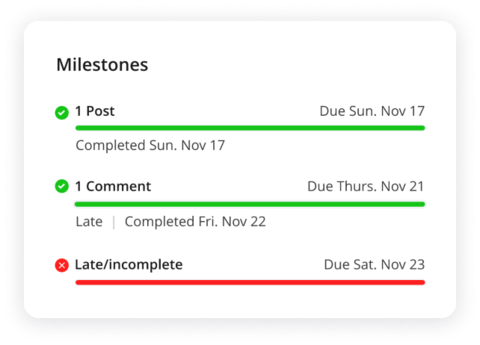
Encourage more frequent engagement with your course with mult