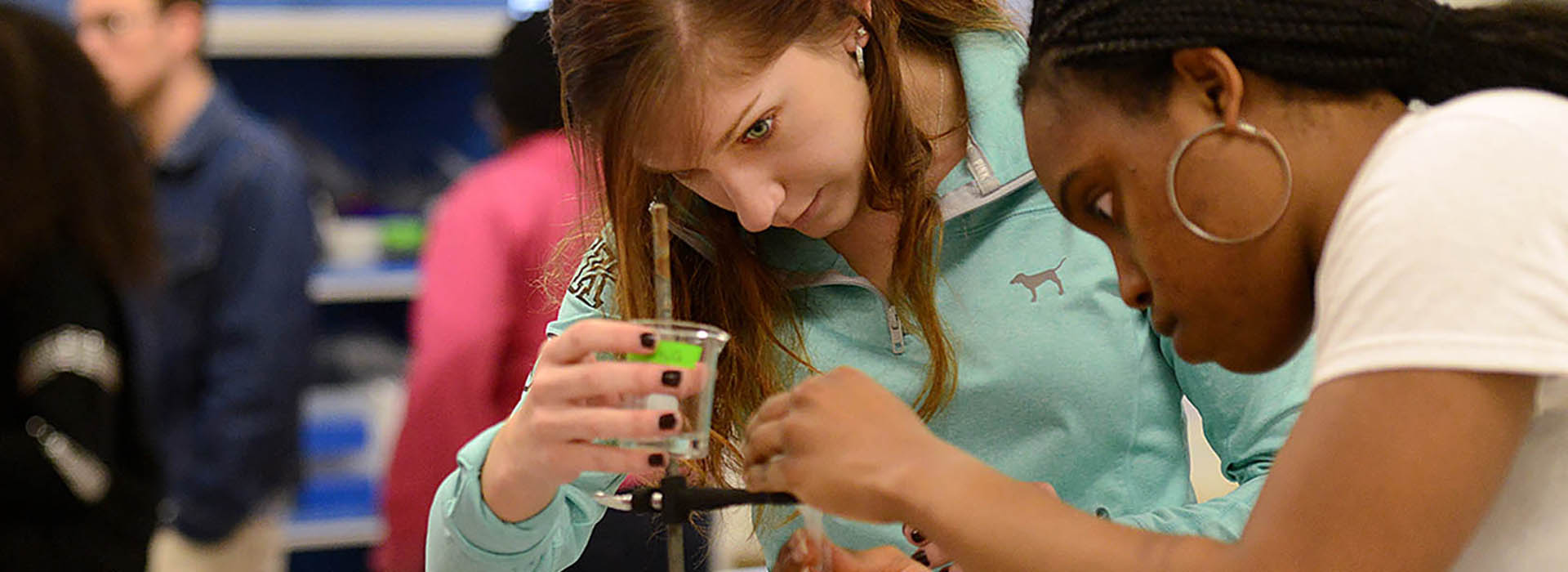
The Biochemistry curriculum is designed to prepare students for the biomedical sciences and/or health professions through a strong background in chemistry and its application to biological systems. The degree, hosted by the Chemistry program in the School of Integrated Sciences, Sustainability and Public Health, meets or exceeds the requirements for those students pursuing a professional degree, e.g. medicine, dentistry and pharmacy, as well as those interested in graduate work in associated sciences, e.g. biochemistry, pharmacology and molecular biology. The program is accredited by the American Chemical Society's Committee on Professional Training and the curriculum meets the recommendations of the American Society for Biochemistry and Molecular Biology.
Learning Outcomes
- Integrate chemical knowledge with biological knowledge
- Be proficient in appropriate laboratory skills
- Communicate scientific information
- Apply the scientific process
- Participate in the biochemistry profession
Calendar
Don't miss an important date or deadline
Designed for working professionals, UIS programs feature multiple start dates per year, so you can begin at the time that best fits your schedule and complete your degree quickly. View the Academic Calendar
Tuition & Aid
UIS is the most affordable option to earning your University of Illinois degree. Earn a world-class education for less than you’d expect.
Tuition Estimates
On-campus
$11,535/yr*
Based on 120 credit hours over 4 years.
*These numbers represent an estimate of the in-state tuition cost for this program and do not include fees. To get an estimate of the full cost of attendance check out the cost of attendance page and/or use the tuition calculator.
Ways to Save on Tuition
Admissions
Applying to UIS is simple
We've streamlined our admission process to save you time and effort. Just follow the steps below.
Review admission requirements
No specific admission requirements are listed at this time. Please contact the Office of Admission for more information.
International students, will you need an F-1 student visa to study on campus at UIS? Please review the International Applicants site for additional information.
Complete your application
An email address is required to create an account. To submit a paper application, visit the Resources & Forms page. Find more information about what type of student you are on the Student Types page. Applying for an online program is the same procedure as applying for an on-campus program.
Send your official transcripts
Email your official or certified academic records/transcripts to incomingtranscripts@uis.edu or through any of the major transcript platforms. Photocopies will not be accepted.
Submit required statements/writing sample
If you are a first-year student, a statement of 250-650 words is required for admission. We want to hear about your professional aspirations, intellectual interests, and personal experiences relevant to your choice of a specific academic program. You can upload the required documents on your application status page.
Pay your application fee
You can submit your non-refundable application fee online, after completing the online application. Alternately, it can also be mailed to the university, payable to University of Illinois Springfield.
Domestic students: Undergraduate - $50, Graduate - $60;
International students: Undergraduate - $60, Graduate - $75.

Voted No. 1 public regional university in Illinois
2020 - 2024
Courses & Catalog Information
At the University of Illinois Springfield, you'll find a wide range of courses tailored to your interests and career goals. Explore your program details and get all the essential information you need to plan your future.
Career Outlook & Potential Earnings
Graduates of this program may find opportunities in the following careers. Data sourced from O*NET OnLine by the U.S. Department of Labor.
Rehabilitation Counselors
Counsel individuals to maximize the independence and employability of persons coping with personal, social, and vocational difficulties that result from birth defects, illness, disease, accidents, agi
Counsel individuals to maximize the independence and employability of persons coping with personal, social, and vocational difficulties that result from birth defects, illness, disease, accidents, aging, or the stress of daily life. Coordinate activities for residents of care and treatment facilities. Assess client needs and design and implement rehabilitation programs that may include personal and vocational counseling, training, and job placement.
Median Annual Wage
$46,850
Wage Range
$35,060 – $77,170
Projected Growth
Below Average
Top Skills:
Typical Education:
Master’s degree, Bachelor’s degree, Post-master’s certificate
Chemical Technicians
Conduct chemical and physical laboratory tests to assist scientists in making qualitative and quantitative analyses of solids, liquids, and gaseous materials for research and development of new produc
Conduct chemical and physical laboratory tests to assist scientists in making qualitative and quantitative analyses of solids, liquids, and gaseous materials for research and development of new products or processes, quality control, maintenance of environmental standards, and other work involving experimental, theoretical, or practical application of chemistry and related sciences.
Median Annual Wage
$60,390
Wage Range
$41,740 – $92,040
Projected Growth
Average
Top Skills:
Typical Education:
Bachelor’s degree, High school diploma or equivalent, Some college, no degree
Social Science Research Assistants
Assist social scientists in laboratory, survey, and other social science research. May help prepare findings for publication and assist in laboratory analysis, quality control, or data management.
Median Annual Wage
$61,990
Wage Range
$38,090 – $102,070
Projected Growth
Average
Top Skills:
Typical Education:
Bachelor’s degree, Master’s degree, Some college, no degree
Chemists
Bright OutlookConduct qualitative and quantitative chemical analyses or experiments in laboratories for quality or process control or to develop new products or knowledge.
Median Annual Wage
$91,240
Wage Range
$58,460 – $160,830
Projected Growth
Bright
Top Skills:
Typical Education:
Bachelor’s degree, Doctoral degree, Master’s degree
Environmental Science and Protection Technicians, Including Health
Perform laboratory and field tests to monitor the environment and investigate sources of pollution, including those that affect health, under the direction of an environmental scientist, engineer, or
Perform laboratory and field tests to monitor the environment and investigate sources of pollution, including those that affect health, under the direction of an environmental scientist, engineer, or other specialist. May collect samples of gases, soil, water, and other materials for testing.
Median Annual Wage
$55,090
Wage Range
$38,170 – $94,160
Projected Growth
Average
Top Skills:
Typical Education:
Bachelor’s degree, Associate’s degree or other 2-year degree, High school diploma or equivalent
Quality Control Analysts
Conduct tests to determine quality of raw materials, bulk intermediate and finished products. May conduct stability sample tests.
Median Annual Wage
$62,280
Wage Range
$39,000 – $102,690
Projected Growth
Average
Top Skills:
Typical Education:
High school diploma or equivalent, Bachelor’s degree, Post-secondary certificate
Have Questions? We Can Help!
Say #YestoUIS