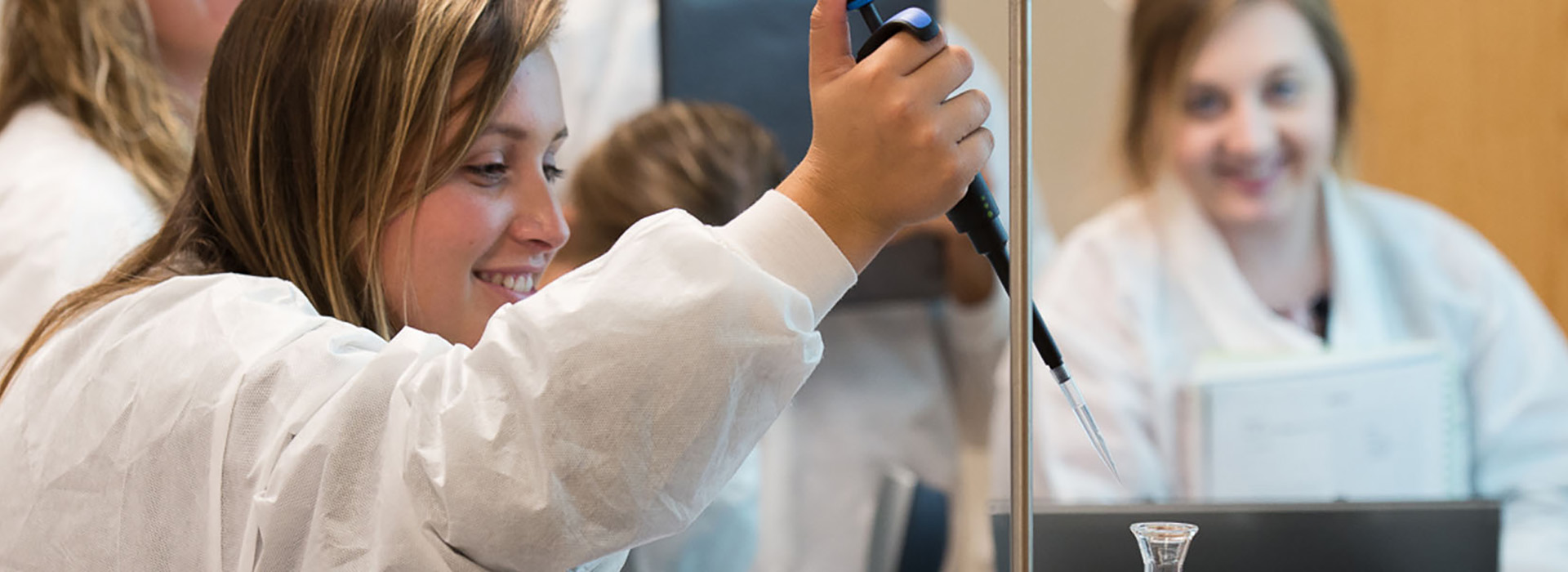
A degree in Biology can open doors to many interesting and exciting careers. At UIS, the Biology degree is a hands-on process: students work directly with the equipment and learn through a balanced curriculum that strengthens both intellectual and practical skills.
Students actively participate in research through faculty research interests in molecular, cellular and organismal biology. Scientific facilities available to students include a new, well-equipped building with research laboratories. Because UIS is located in the state capital of Illinois, there are many opportunities for internships that help students gain valuable on-the-job experience.
Our students are prepared for further training in biology—including medical and other professional schools—and for careers in biology in the public and private sectors. UIS offers a Bachelor of Science (B.S.) in Biology.
Learning Outcomes
- Design and conduct a scientific study to investigate biological systems.
- Articulate and apply the concepts of cellular biology, organismal biology, ecology and evolution.
- Explain the molecular basis of heredity and the processes of biological evolution.
- Integrate the knowledge they have obtained across their biology course work to address applied issues.
- Communicate effectively in written and oral scientific formats.
- Understand the core concepts in genetics, ecology and molecular biology.
- Develop strong analytical and lab skills.
- Apply biological knowledge to solve environmental and health-related issues.
Calendar
Don't miss an important date or deadline
Designed for working professionals, UIS programs feature multiple start dates per year, so you can begin at the time that best fits your schedule and complete your degree quickly. View the Academic Calendar
Tuition & Aid
UIS is the most affordable option to earning your University of Illinois degree. Earn a world-class education for less than you’d expect.
Tuition Estimates
On-campus
$11,535/yr*
Based on 120 credit hours over 4 years.
*These numbers represent an estimate of the in-state tuition cost for this program and do not include fees. To get an estimate of the full cost of attendance check out the cost of attendance page and/or use the tuition calculator.
Ways to Save on Tuition
Admissions
Applying to UIS is simple
We've streamlined our admission process to save you time and effort. Just follow the steps below.
Review admission requirements
No specific admission requirements are listed at this time. Please contact the Office of Admission for more information.
International students, will you need an F-1 student visa to study on campus at UIS? Please review the International Applicants site for additional information.
Complete your application
An email address is required to create an account. To submit a paper application, visit the Resources & Forms page. Find more information about what type of student you are on the Student Types page. Applying for an online program is the same procedure as applying for an on-campus program.
Send your official transcripts
Email your official or certified academic records/transcripts to incomingtranscripts@uis.edu or through any of the major transcript platforms. Photocopies will not be accepted.
Submit required statements/writing sample
If you are a first-year student, a statement of 250-650 words is required for admission. We want to hear about your professional aspirations, intellectual interests, and personal experiences relevant to your choice of a specific academic program. You can upload the required documents on your application status page.
Pay your application fee
You can submit your non-refundable application fee online, after completing the online application. Alternately, it can also be mailed to the university, payable to University of Illinois Springfield.
Domestic students: Undergraduate - $50, Graduate - $60;
International students: Undergraduate - $60, Graduate - $75.

Voted No. 1 public regional university in Illinois
2020 - 2024
Courses & Catalog Information
At the University of Illinois Springfield, you'll find a wide range of courses tailored to your interests and career goals. Explore your program details and get all the essential information you need to plan your future.
Career Outlook & Potential Earnings
Graduates of this program may find opportunities in the following careers. Data sourced from O*NET OnLine by the U.S. Department of Labor.
Biological Technicians
Bright OutlookAssist biological and medical scientists. Set up, operate, and maintain laboratory instruments and equipment, monitor experiments, collect data and samples, make observations, and calculate and record
Assist biological and medical scientists. Set up, operate, and maintain laboratory instruments and equipment, monitor experiments, collect data and samples, make observations, and calculate and record results. May analyze organic substances, such as blood, food, and drugs.
Median Annual Wage
$57,510
Wage Range
$40,330 – $84,940
Projected Growth
Bright
Top Skills:
Typical Education:
Bachelor’s degree, High school diploma or equivalent, Some college, no degree
Environmental Scientists and Specialists, Including Health
Bright OutlookConduct research or perform investigation for the purpose of identifying, abating, or eliminating sources of pollutants or hazards that affect either the environment or public health. Using knowledge
Conduct research or perform investigation for the purpose of identifying, abating, or eliminating sources of pollutants or hazards that affect either the environment or public health. Using knowledge of various scientific disciplines, may collect, synthesize, study, report, and recommend action based on data derived from measurements or observations of air, food, soil, water, and other sources.
Median Annual Wage
$82,220
Wage Range
$52,520 – $140,010
Projected Growth
Bright
Top Skills:
Typical Education:
Bachelor’s degree
Health Education Specialists
Bright OutlookProvide and manage health education programs that help individuals, families, and their communities maximize and maintain healthy lifestyles. Use data to identify community needs prior to planning, im
Provide and manage health education programs that help individuals, families, and their communities maximize and maintain healthy lifestyles. Use data to identify community needs prior to planning, implementing, monitoring, and evaluating programs designed to encourage healthy lifestyles, policies, and environments. May link health systems, health providers, insurers, and patients to address individual and population health needs. May serve as resource to assist individuals, other health professionals, or the community, and may administer fiscal resources for health education programs.
Median Annual Wage
$64,070
Wage Range
$42,990 – $118,200
Projected Growth
Bright
Top Skills:
Typical Education:
Associate’s degree or other 2-year degree, Bachelor’s degree, High school diploma or equivalent
Bioengineers and Biomedical Engineers
Bright OutlookApply knowledge of engineering, biology, chemistry, computer science, and biomechanical principles to the design, development, and evaluation of biological, agricultural, and health systems and produc
Apply knowledge of engineering, biology, chemistry, computer science, and biomechanical principles to the design, development, and evaluation of biological, agricultural, and health systems and products, such as artificial organs, prostheses, instrumentation, medical information systems, and health management and care delivery systems.
Median Annual Wage
$109,370
Wage Range
$71,850 – $168,180
Projected Growth
Bright
Top Skills:
Typical Education:
Bachelor’s degree, Master’s degree, Doctoral degree
Ophthalmic Laboratory Technicians
Cut, grind, and polish eyeglasses, contact lenses, or other precision optical elements. Assemble and mount lenses into frames or process other optical elements. Includes precision lens polishers or gr
Cut, grind, and polish eyeglasses, contact lenses, or other precision optical elements. Assemble and mount lenses into frames or process other optical elements. Includes precision lens polishers or grinders, centerer-edgers, and lens mounters.
Median Annual Wage
$39,460
Wage Range
$33,530 – $57,380
Projected Growth
Below Average
Top Skills:
Typical Education:
High school diploma or equivalent, Some college, no degree, Post-secondary certificate
Biological Science Teachers, Postsecondary
Bright OutlookTeach courses in biological sciences. Includes both teachers primarily engaged in teaching and those who do a combination of teaching and research.
Median Annual Wage
$84,620
Wage Range
$52,150 – $169,900
Projected Growth
Bright
Top Skills:
Typical Education:
Doctoral degree, Post-doctoral training, Master’s degree
Have Questions? We Can Help!
Say #YestoUIS