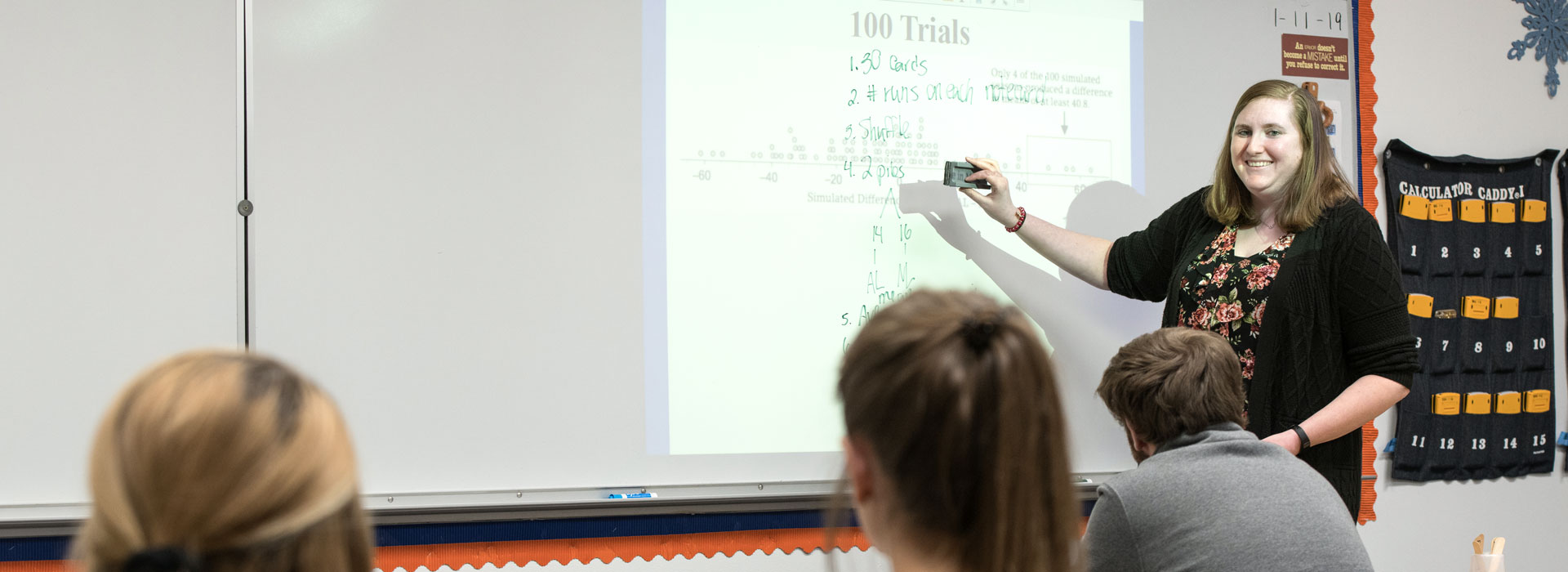
The Department of Teacher Education at UIS offers a minor in education that leads to licensure at the secondary level when combined with an appropriate academic major, fulfillment of general education requirements and satisfaction of campus requirements. Candidates seeking a bachelor’s degree and a minor secondary licensure should expect that their total program of study can usually be completed within the four-year time frame, but may exceed the minimum number of hours required for graduation. Secondary education candidates may major in one of several programs leading to licensure in the areas of English, mathematics, science, or social science. The Initial Program Adviser can recommend appropriate majors.
Minor in Secondary Education when paired with a degree in:
- Political Science
- Sociology/Anthropology
- Chemistry
- Biology
- Math
- English
- History
Those candidates seeking a content area degree and minor in Secondary Education may go beyond the usual 120 credits to complete the requirements of both the degree and the minor. Students wishing to add additional teaching areas (e.g., another content area, LBS1, or Middle Grades) should discuss these goals with their School of Education Advisor for additional details.
Those who have previously earned a bachelor’s degree or higher from an accredited U.S. institution of higher education may pursue licensure via a licensure only, non-degree seeking route. This plan allows for use of previously earned coursework to count toward equivalent coursework required for educator licensure in Illinois. Grade ranges and content areas noted above in the degree seeking sections are all available via this licensure only route.
Calendar
Don't miss an important date or deadline
Designed for working professionals, UIS programs feature multiple start dates per year, so you can begin at the time that best fits your schedule and complete your degree quickly. View the Academic Calendar
Admissions
Applying to UIS is simple
We've streamlined our admission process to save you time and effort. Just follow the steps below.
Review admission requirements
No specific admission requirements are listed at this time. Please contact the Office of Admission for more information.
International students, will you need an F-1 student visa to study on campus at UIS? Please review the International Applicants site for additional information.
Complete your application
An email address is required to create an account. To submit a paper application, visit the Resources & Forms page. Find more information about what type of student you are on the Student Types page. Applying for an online program is the same procedure as applying for an on-campus program.
Send your official transcripts
Email your official or certified academic records/transcripts to incomingtranscripts@uis.edu or through any of the major transcript platforms. Photocopies will not be accepted.
Submit required statements/writing sample
If you are a first-year student, a statement of 250-650 words is required for admission. We want to hear about your professional aspirations, intellectual interests, and personal experiences relevant to your choice of a specific academic program. You can upload the required documents on your application status page.
Pay your application fee
You can submit your non-refundable application fee online, after completing the online application. Alternately, it can also be mailed to the university, payable to University of Illinois Springfield.
Domestic students: Undergraduate - $50, Graduate - $60;
International students: Undergraduate - $60, Graduate - $75.

Voted No. 1 public regional university in Illinois
2020 - 2024
Courses & Catalog Information
At the University of Illinois Springfield, you'll find a wide range of courses tailored to your interests and career goals. Explore your program details and get all the essential information you need to plan your future.
Career Outlook & Potential Earnings
Graduates of this program may find opportunities in the following careers. Data sourced from O*NET OnLine by the U.S. Department of Labor.
Special Education Teachers, Secondary School
Teach academic, social, and life skills to secondary school students with learning, emotional, or physical disabilities. Includes teachers who specialize and work with students who are blind or have v
Teach academic, social, and life skills to secondary school students with learning, emotional, or physical disabilities. Includes teachers who specialize and work with students who are blind or have visual impairments; students who are deaf or have hearing impairments; and students with intellectual disabilities.
Median Annual Wage
$74,260
Wage Range
$49,800 – $109,100
Projected Growth
Below Average
Top Skills:
Typical Education:
Bachelor’s degree, Master’s degree, Post-baccalaureate certificate
Secondary School Teachers, Except Special and Career/Technical Education
Teach one or more subjects to students at the secondary school level.
Median Annual Wage
$72,040
Wage Range
$48,780 – $107,600
Projected Growth
Below Average
Top Skills:
Typical Education:
Bachelor’s degree, Post-baccalaureate certificate, Post-master’s certificate
Education Administrators, Kindergarten through Secondary
Plan, direct, or coordinate the academic, administrative, or auxiliary activities of kindergarten, elementary, or secondary schools.
Median Annual Wage
$105,870
Wage Range
$76,280 – $167,770
Projected Growth
Below Average
Top Skills:
Typical Education:
Master’s degree, Bachelor’s degree, Post-master’s certificate
Adult Basic Education, Adult Secondary Education, and English as a Second Language Instructors
Teach or instruct out-of-school youths and adults in basic education, literacy, or English as a Second Language classes, or in classes for earning a high school equivalency credential.
Median Annual Wage
$61,540
Wage Range
$41,810 – $98,030
Projected Growth
Below Average
Top Skills:
Typical Education:
Bachelor’s degree, Master’s degree, High school diploma or equivalent
Career/Technical Education Teachers, Secondary School
Teach occupational, vocational, career, or technical subjects to students at the secondary school level.
Median Annual Wage
$66,270
Wage Range
$50,040 – $101,340
Projected Growth
Below Average
Top Skills:
Typical Education:
Bachelor’s degree, Master’s degree, Associate’s degree or other 2-year degree
Teaching Assistants, Preschool, Elementary, Middle, and Secondary School, Except Special Education
Assist a preschool, elementary, middle, or secondary school teacher with instructional duties. Serve in a position for which a teacher has primary responsibility for the design and implementation of e
Assist a preschool, elementary, middle, or secondary school teacher with instructional duties. Serve in a position for which a teacher has primary responsibility for the design and implementation of educational programs and services.
Median Annual Wage
$36,780
Wage Range
$27,150 – $50,040
Projected Growth
Below Average
Top Skills:
Typical Education:
High school diploma or equivalent, Post-secondary certificate, Some college, no degree
Say #YestoUIS