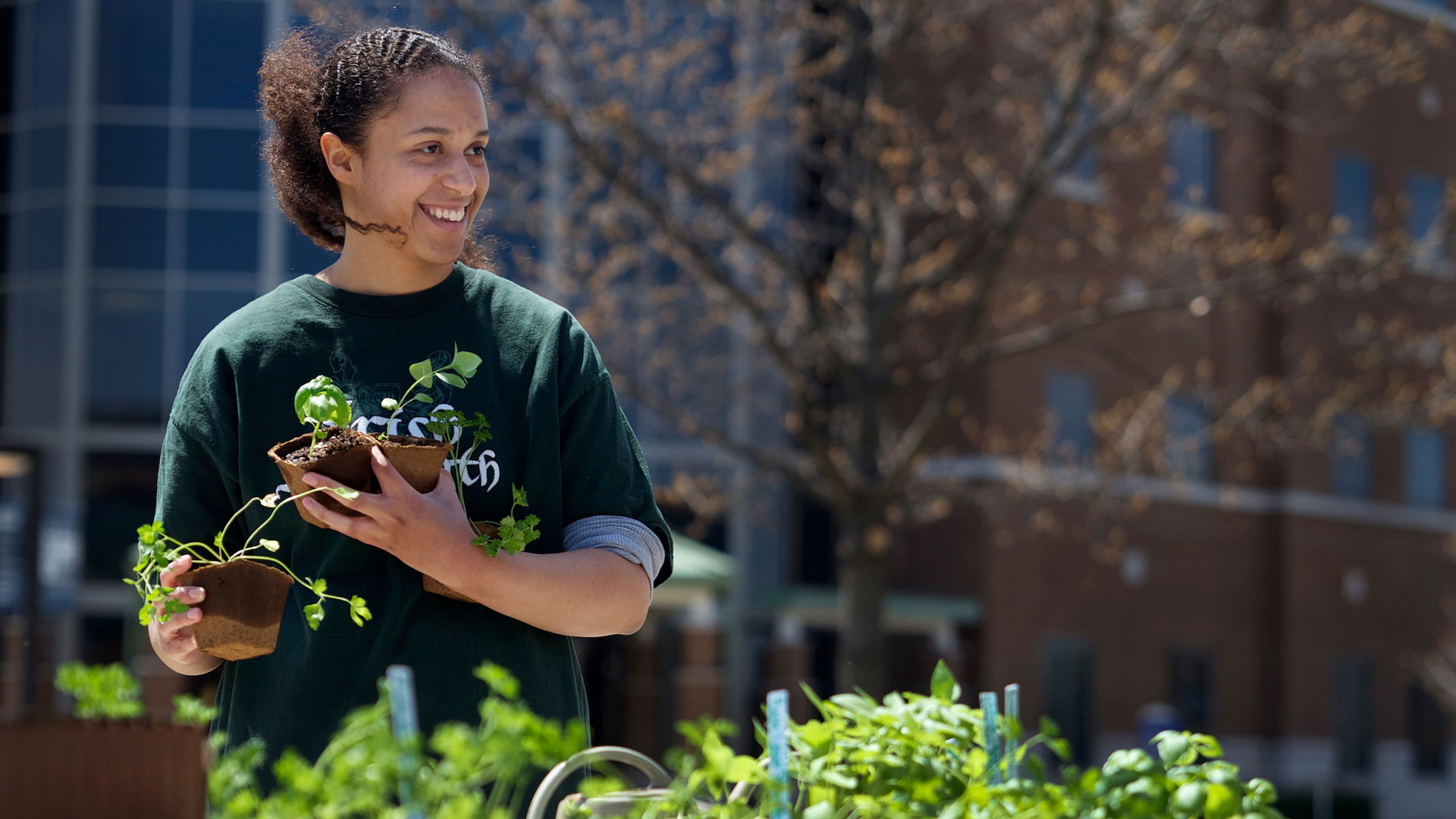
The MPH-Environmental Health (EH) degree provided by the public health program offers cross-disciplinary education opportunities and intentional integration of science, technology, engineering, mathematics (STEM) and associated practices. The MPH-EH program is a STEM-Designated degree and accredited curriculum through the National Environmental Health, Science and Protection Accreditation Council (EHAC).
Learning Outcomes
- Apply epidemiological methods to settings and situations in public health practice.
- Select quantitative and qualitative data collection methods appropriate for a given public health context.
- Analyze quantitative and qualitative data using biostatistics, informatics, computer-based programming and software, as appropriate.
- Interpret results of data analysis for public health research, policy, or practice.
- Compare the organization, structure and function of health care, public health and regulatory systems across national and international settings.
- Discuss the means by which structural bias, social inequities and racism undermine health and create challenges to achieving health equity at organizational, community and systemic levels.
- Assess population needs, assets and capacities that affect communities’ health.
- Apply awareness of cultural values and practices to the design, implementation, or critique of public health policies or programs.
- Design a population-based policy, program, project or intervention.
- Explain basic principles and tools of budget and resource management.
- Select methods to evaluate public health programs.
- Discuss the policy-making process, including the roles of ethics and evidence.
- Propose strategies to identify stakeholders and build coalitions and partnerships for influencing public health outcomes.
- Advocate for political, social or economic policies and programs that will improve health in diverse populations.
- Evaluate policies for their impact on public health and health equity.
- Apply leadership and/or management principles to address a relevant issue.
- Apply negotiation and mediation skills to address organizational or community challenges.
- Select communication strategies for different audiences and sectors.
- Communicate audience-appropriate (i.e., non-academic, non-peer audience) public health content, both in writing and through oral presentation.
- Describe the importance of cultural competence in communicating public health content.
- Integrate perspectives from other sectors and/or professions to promote and advance population health.
- Apply a systems thinking tool to visually represent a public health issue in a format other than standard narrative.
Calendar
Don't miss an important date or deadline
Designed for working professionals, UIS programs feature multiple start dates per year, so you can begin at the time that best fits your schedule and complete your degree quickly. View the Academic Calendar
Tuition & Aid
UIS is the most affordable option to earning your University of Illinois degree. Earn a world-class education for less than you’d expect.
Tuition Estimates
On-campus
$8,544/yr*
Online
$9,222/yr*
Based on 48 credit hours over 2 years.
*These numbers represent an estimate of the in-state tuition cost for this program and do not include fees. To get an estimate of the full cost of attendance check out the cost of attendance page and/or use the tuition calculator.
Ways to Save on Tuition
Admissions
Applying to UIS is simple
We've streamlined our admission process to save you time and effort. Just follow the steps below.
Review admission requirements
No specific admission requirements are listed at this time. Please contact the Office of Admission for more information.
International students, will you need an F-1 student visa to study on campus at UIS? Please review the International Applicants site for additional information.
Complete your application
An email address is required to create an account. To submit a paper application, visit the Resources & Forms page. Find more information about what type of student you are on the Student Types page. Applying for an online program is the same procedure as applying for an on-campus program.
Send your official transcripts
Email your official or certified academic records/transcripts to incomingtranscripts@uis.edu or through any of the major transcript platforms. Photocopies will not be accepted.
Submit required statements/writing sample
If you are a first-year student, a statement of 250-650 words is required for admission. We want to hear about your professional aspirations, intellectual interests, and personal experiences relevant to your choice of a specific academic program. You can upload the required documents on your application status page.
Pay your application fee
You can submit your non-refundable application fee online, after completing the online application. Alternately, it can also be mailed to the university, payable to University of Illinois Springfield.
Domestic students: Undergraduate - $50, Graduate - $60;
International students: Undergraduate - $60, Graduate - $75.

Voted No. 1 public regional university in Illinois
2020 - 2024
Courses & Catalog Information
At the University of Illinois Springfield, you'll find a wide range of courses tailored to your interests and career goals. Explore your program details and get all the essential information you need to plan your future.
Career Outlook & Potential Earnings
Graduates of this program may find opportunities in the following careers. Data sourced from O*NET OnLine by the U.S. Department of Labor.
Epidemiologists
Bright OutlookInvestigate and describe the determinants and distribution of disease, disability, or health outcomes. May develop the means for prevention and control.
Median Annual Wage
$87,220
Wage Range
$61,270 – $138,800
Projected Growth
Bright
Top Skills:
Typical Education:
Master’s degree, Post-doctoral training, Doctoral degree
Medical Scientists, Except Epidemiologists
Bright OutlookConduct research dealing with the understanding of human diseases and the improvement of human health. Engage in clinical investigation, research and development, or other related activities.
Median Annual Wage
$103,410
Wage Range
$64,800 – $177,780
Projected Growth
Bright
Top Skills:
Typical Education:
Doctoral degree, Master’s degree, Post-doctoral training
Environmental Scientists and Specialists, Including Health
Bright OutlookConduct research or perform investigation for the purpose of identifying, abating, or eliminating sources of pollutants or hazards that affect either the environment or public health. Using knowledge
Conduct research or perform investigation for the purpose of identifying, abating, or eliminating sources of pollutants or hazards that affect either the environment or public health. Using knowledge of various scientific disciplines, may collect, synthesize, study, report, and recommend action based on data derived from measurements or observations of air, food, soil, water, and other sources.
Median Annual Wage
$82,220
Wage Range
$52,520 – $140,010
Projected Growth
Bright
Top Skills:
Typical Education:
Bachelor’s degree
Climate Change Policy Analysts
Bright OutlookResearch and analyze policy developments related to climate change. Make climate-related recommendations for actions such as legislation, awareness campaigns, or fundraising approaches.
Median Annual Wage
$82,220
Wage Range
$52,520 – $140,010
Projected Growth
Bright
Top Skills:
Typical Education:
Master’s degree, Bachelor’s degree, Doctoral degree
Environmental Restoration Planners
Bright OutlookCollaborate with field and biology staff to oversee the implementation of restoration projects and to develop new products. Process and synthesize complex scientific data into practical strategies for
Collaborate with field and biology staff to oversee the implementation of restoration projects and to develop new products. Process and synthesize complex scientific data into practical strategies for restoration, monitoring or management.
Median Annual Wage
$82,220
Wage Range
$52,520 – $140,010
Projected Growth
Bright
Top Skills:
Typical Education:
Bachelor’s degree, Master’s degree, Post-baccalaureate certificate
Industrial Ecologists
Bright OutlookApply principles and processes of natural ecosystems to develop models for efficient industrial systems. Use knowledge from the physical and social sciences to maximize effective use of natural resour
Apply principles and processes of natural ecosystems to develop models for efficient industrial systems. Use knowledge from the physical and social sciences to maximize effective use of natural resources in the production and use of goods and services. Examine societal issues and their relationship with both technical systems and the environment.
Median Annual Wage
$82,220
Wage Range
$52,520 – $140,010
Projected Growth
Bright
Top Skills:
Typical Education:
Master’s degree, Bachelor’s degree, Doctoral degree

Have Questions? We Can Help!
Say #YestoUIS