Build the skills to protect systems, data, and digital information.
The Bachelor of Science in Cybersecurity at UIS prepares you to understand and address today's information security challenges. You'll learn how to design and implement secure systems, assess security risks, and apply cybersecurity best practices and ethics.
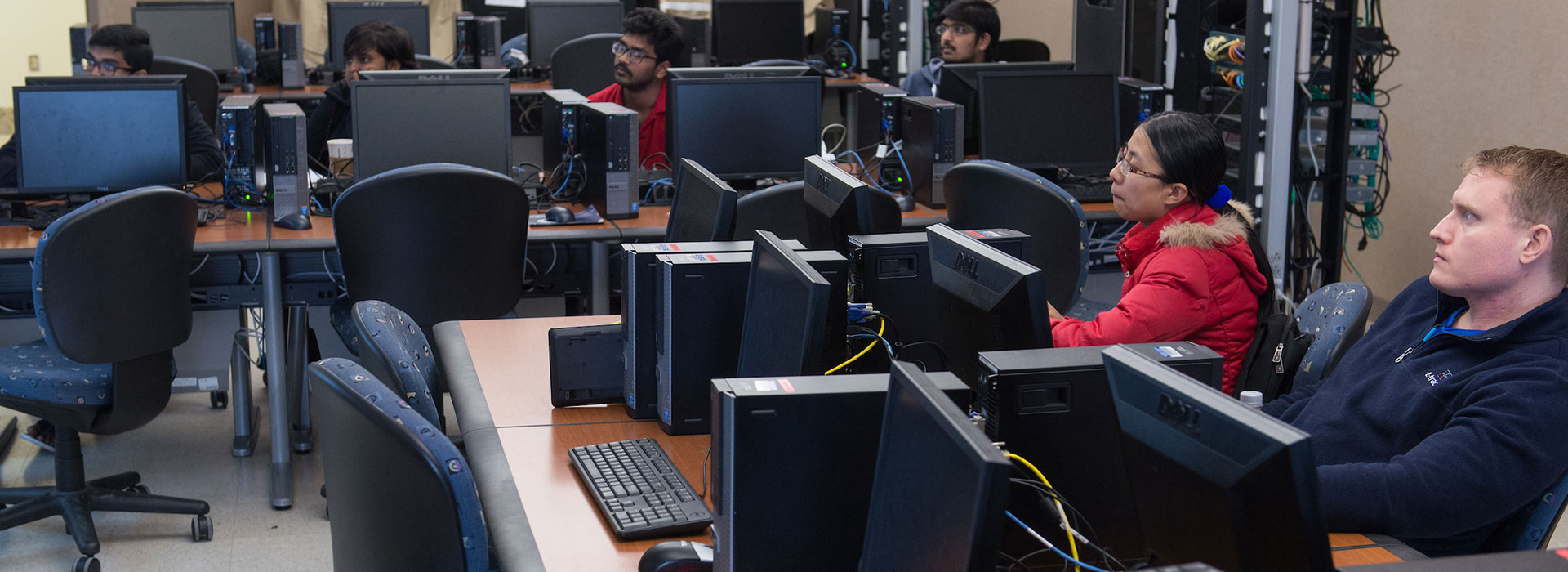
Through hands-on learning, you'll work with cutting-edge technologies and cybersecurity labs to apply what you learn to real-world security challenges.
What You'll Learn
- Understand key concepts and principles of cybersecurity.
- Communicate and apply security best practices.
- Design and implement secure systems.
- Assess security risks and address information security challenges.
- Apply ethical principles to cybersecurity practices.
Calendar
Don't miss an important date or deadline
Designed for working professionals, UIS programs feature multiple start dates per year, so you can begin at the time that best fits your schedule and complete your degree quickly. View the Academic Calendar

Tuition & Aid
UIS is the most affordable option to earning your University of Illinois degree. Earn a world-class education for less than you’d expect.
Value of a UIS Degree

UIS is No. 5 for students graduating with the least amount of debt, Midwest Region (2021).

Top 25 best value school, Midwest Region, and the only public university in Illinois on the list (2022, 2023, 2024).

98% of students receive aid
The average graduate from UIS will see an increase in earnings of $31,700 - $69,000 each year compared to someone with a high school diploma working in Illinois.
Admissions
Applying to UIS is simple
We've streamlined our admission process to save you time and effort. Just follow the steps below.
Review admission requirements
No specific admission requirements are listed at this time. Please contact the Office of Admission for more information.
International students, will you need an F-1 student visa to study on campus at UIS? Please review the International Applicants site for additional information.
Complete your application
An email address is required to create an account. To submit a paper application, visit the Resources & Forms page. Find more information about what type of student you are on the Student Types page. Applying for an online program is the same procedure as applying for an on-campus program.
Send your official transcripts
Email your official or certified academic records/transcripts to incomingtranscripts@uis.edu or through any of the major transcript platforms. Photocopies will not be accepted.
Submit required statements/writing sample
If you are a first-year student, a statement of 250-650 words is required for admission. We want to hear about your professional aspirations, intellectual interests, and personal experiences relevant to your choice of a specific academic program. You can upload the required documents on your application status page.
Pay your application fee
You can submit your non-refundable application fee online, after completing the online application. Alternately, it can also be mailed to the university, payable to University of Illinois Springfield.
Domestic students: Undergraduate - $50, Graduate - $60;
International students: Undergraduate - $60, Graduate - $75.

Voted No. 1 public regional university in Illinois
2020 - 2024
Courses & Catalog Information
At the University of Illinois Springfield, you'll find a wide range of courses tailored to your interests and career goals. Explore your program details and get all the essential information you need to plan your future.
Career Outlook & Potential Earnings
Graduates of this program may find opportunities in the following careers. Data sourced from O*NET OnLine by the U.S. Department of Labor.
Penetration Testers
Bright OutlookEvaluate network system security by conducting simulated internal and external cyberattacks using adversary tools and techniques. Attempt to breach and exploit critical systems and gain access to sens
Evaluate network system security by conducting simulated internal and external cyberattacks using adversary tools and techniques. Attempt to breach and exploit critical systems and gain access to sensitive information to assess system security.
Median Annual Wage
$116,580
Wage Range
$55,940 – $188,470
Projected Growth
Bright
Top Skills:
Typical Education:
Bachelor’s degree, Post-secondary certificate, High school diploma or equivalent
Blockchain Engineers
Bright OutlookMaintain and support distributed and decentralized blockchain-based networks or block-chain applications such as cryptocurrency exchange, payment processing, document sharing, and digital voting. Desi
Maintain and support distributed and decentralized blockchain-based networks or block-chain applications such as cryptocurrency exchange, payment processing, document sharing, and digital voting. Design and deploy secure block-chain design patterns and solutions over geographically distributed networks using advanced technologies. May assist with infrastructure setup and testing for application transparency and security.
Median Annual Wage
$116,580
Wage Range
$55,940 – $188,470
Projected Growth
Bright
Top Skills:
Typical Education:
Bachelor’s degree, Some college, no degree, Master’s degree
Computer Network Architects
Bright OutlookDesign and implement computer and information networks, such as local area networks (LAN), wide area networks (WAN), intranets, extranets, and other data communications networks. Perform network model
Design and implement computer and information networks, such as local area networks (LAN), wide area networks (WAN), intranets, extranets, and other data communications networks. Perform network modeling, analysis, and planning, including analysis of capacity needs for network infrastructures. May also design network and computer security measures. May research and recommend network and data communications hardware and software.
Median Annual Wage
$134,050
Wage Range
$79,900 – $202,680
Projected Growth
Bright
Top Skills:
Typical Education:
Bachelor’s degree, Post-secondary certificate, Associate’s degree or other 2-year degree
Software Quality Assurance Analysts and Testers
Bright OutlookDevelop and execute software tests to identify software problems and their causes. Test system modifications to prepare for implementation. Document software and application defects using a bug tracki
Develop and execute software tests to identify software problems and their causes. Test system modifications to prepare for implementation. Document software and application defects using a bug tracking system and report defects to software or web developers. Create and maintain databases of known defects. May participate in software design reviews to provide input on functional requirements, operational characteristics, product designs, and schedules.
Median Annual Wage
$104,300
Wage Range
$61,440 – $167,010
Projected Growth
Bright
Top Skills:
Typical Education:
Bachelor’s degree, Associate’s degree or other 2-year degree, Post-secondary certificate
Information Security Engineers
Bright OutlookDevelop and oversee the implementation of information security procedures and policies. Build, maintain and upgrade security technology, such as firewalls, for the safe use of computer networks and th
Develop and oversee the implementation of information security procedures and policies. Build, maintain and upgrade security technology, such as firewalls, for the safe use of computer networks and the transmission and retrieval of information. Design and implement appropriate security controls to identify vulnerabilities and protect digital files and electronic infrastructures. Monitor and respond to computer security breaches, viruses, and intrusions, and perform forensic investigation. May oversee the assessment of information security systems.
Median Annual Wage
$116,580
Wage Range
$55,940 – $188,470
Projected Growth
Bright
Top Skills:
Typical Education:
Bachelor’s degree, Post-secondary certificate, Some college, no degree
Network and Computer Systems Administrators
Install, configure, and maintain an organization's local area network (LAN), wide area network (WAN), data communications network, operating systems, and physical and virtual servers. Perform system m
Install, configure, and maintain an organization's local area network (LAN), wide area network (WAN), data communications network, operating systems, and physical and virtual servers. Perform system monitoring and verify the integrity and availability of hardware, network, and server resources and systems. Review system and application logs and verify completion of scheduled jobs, including system backups. Analyze network and server resource consumption and control user access. Install and upgrade software and maintain software licenses. May assist in network modeling, analysis, planning, and coordination between network and data communications hardware and software.
Median Annual Wage
$99,130
Wage Range
$62,640 – $155,050
Projected Growth
Below Average
Top Skills:
Typical Education:
Associate’s degree or other 2-year degree, Bachelor’s degree, Post-secondary certificate

Have Questions? We Can Help!
Say #YestoUIS