Once you have conquered the question, who am I, then you’re ready to advance to the Options to Explore stage. This stage primarily encompasses researching information as it pertains to academic majors, career clusters, occupations, labor market data and company profiles to name a few categories.
Whether you need to expand or condense your options, this section will provide the necessary tools. The Career Development Center has already conducted extensive research on a variety of topics with the most up-to-date resources located within this module
Download the Career Planning Worksheet (pdf) to guide you in your exploration.
- Choosing a Major
- Career Exploration
- Graduate School
- Industries
- Diversity Resources
- Summary of Your Options
Choosing a Major
What is your major? You will hear this question from nearly every relative, friend, and student you interact with during your course of study, especially your freshman year.
Your freshman year is a critical time to time to explore which majors are available at UIS your prospective major relates to your future career path. Many students select a college major without first gathering information about their interests and options. This is something that is highly discouraged
Undergraduate Majors
+
Is this the major for me? Answer this question using self-exploration and general education courses to discover what suits your interests in conjunction with your career goals. In the case of most majors, you don’t have to declare yourself until the end of your sophomore year. Did you know that eighty percent of college students change their major at least once? So the next time someone asks, “What are you majoring in?” let them know that you are exploring your options. View the Undergraduate Programs offered at UIS.
Strategies for Choosing a Major
- Explore your interests, abilities, and values.
- Talk to your academic advisor and career counselor.
- Get experience in the field of interest.
- Use assessment tests, vault and other exploration tools available at CDC.
Self-Exploration Questions
Your major and career should be enjoyable so take the time to explore what motivates you.
- What school subjects do you enjoy the most?
- What are your interests, abilities/skills, needs, personality, and values?
- What have you liked most or disliked about school and work experiences?
- What type of lifestyle do you prefer?
What can I do with a UIS degree?
+
Our counselors have created a set of”What Can You Do With” Career Guides that will help you explore your options with each of the majors and programs offered at UIS.
Visit the “What Can You Do With” Career Guides
Additional Resources
+
Undergraduate Related
Graduate Related
Career Exploration
Career exploration can be very exciting but overwhelming due to the number of options available. It may be helpful to think in terms of determining a career path encompassing a variety of occupations.
Discovering all the careers that match your work interest, skills, personality, and values is what the Option to Explore Stage of GOALS is all about. Completing this step will ensure you have sound and valid information about the many careers you may be interested in.
Exploring Career Paths
+
- Completing the Career Analysis Worksheet (PDF) can help you understand your options
- Meeting with a Career Counselor
- Using the Career Pathfinder CDC web-based program
- Reviewing the Career and Major Match on Focus our online career planning system
Graduate School
When considering whether to continue on to grad school directly after acquiring your bachelor’s degree, there are many questions that should be asked before jumping into a degree program.
You should be familiar with the field that you are entering into and both the requirements and expectations that will be placed on you as an entry level (and eventually upper level) employee.
Some factors for you and your career counselor to consider are:
• What are the benefits of working immediately following undergraduate study?
• What level of education you need to enter into your career field?
• What is the value of practical work experience in your career field?
• What are the benefits from moving directly into a graduate program?
• Do your finances allow you to enter into a graduate program?
• Do your personal obligations allow you to enter into a graduate program?
• What programs and specializations do the graduate schools you are considering offer?
• Are you willing to relocate to attend graduate school?
• Are you willing to change your specialization in order to stay local?
Unsure about any of these considerations? Contact the Career Development Center!
Experience vs. Education
+
Although, many professions do not require graduate degrees for their entry level position, some professions require it for their more advanced positions, making it advantageous to have. However, an advanced degree in some career fields can be a hindrance initially, as you have a high level of education but little or no practical experience. For some careers, a bachelor’s degree or a certificate is all that is needed. Another factor to consider is that a degree does not guarantee employment, and in some fields, such as sales, marketing and journalism, work experience is more valuable than an education. Specifically, elementary education majors will not be hired with a Master’s degree and no work experience. School districts may even pay for your graduate degree as you teach.
Timing is Everything
+
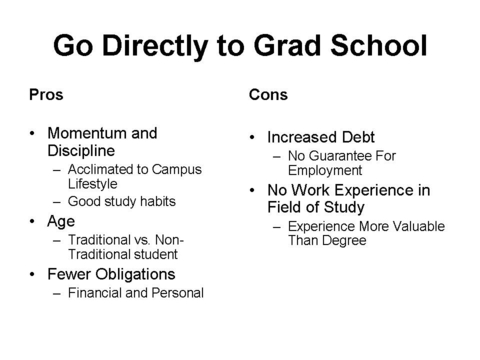
In general, students who continue on immediately after receiving their bachelor’s degree are in academic mode and have less problems breaking into a graduate program. These students also tend to have fewer obligations to the outside world since they have remained in school consistently. Last, there are some careers where the entry level position requires a graduate degree, such as doctors, lawyers and librarians.
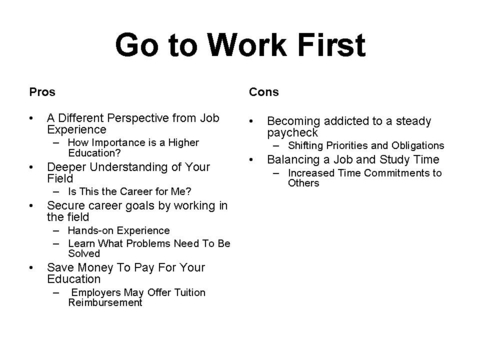
There are also several advantages to working for a few years as well. Following a few years of professional work experience, some people are in a better position to pursue a graduate program. Skills acquired through work experience can usually be applied to graduate degree studies. Financially, these students may be better off, as they have less debt, and employers often finance higher education. Another advantage is that the application process for a graduate program may be easier due to holding solid work experience in the field. However, this may also lead to becoming attached to a salary, making it difficult for some to return to school.
The decision can be a very difficult and stressful one. Stop by the Career Development Center available for more assistance!
Tools for Grad School
+
Grad School Information
Additional Resources
+
Industries
Numerous Industries are available for your career exploration. Knowledge of various industries will assist you in choosing an industry compatible with your field of interest. Utilize the industry descriptions and links below to understand each industry sub-category.
If you are trying to determine whether a particular industry is growing, you can research that industry in much the same way that you have been researching possible careers. Begin your research with a broad net, as you identify the industries that most interest you. Your first resource should be a library that offers an extensive selection of business magazines, such as Fortune, Forbes, Harvard Business Review, Business Week, Industry Week, Barron’s, Money, Nation’s Business, U.S. News & World Report, Time, Newsweek, and specific industry trade journals. Major metropolitan newspapers publish industry trend articles as well. Local business journals many times produce an annual directory of companies organized by industry.
What are you looking for in all of this industry information? When perusing your resources, you want to determine current trends, vocabulary, company rankings/competition, government regulations and issues, customers, distribution channels, new products, and the overall health of the industry. This information will provide you the framework and background you need to explore the fields that interest you. A list of resources are available below to assist in your research.
Company Profiles
+
Employers perceive “researching the company” as a critical factor in the evaluation of applicants because it reflects interest and enthusiasm. Best practices for learning about Companies:
Visit the companies webpages you are interested in and attend interviews well-informed regarding the company’s mission, goals, methods and recent trends.
Diversity Resources
Please see our Diversity Resources page for more details.
Summary of Your Options
CONGRATS - You’ve completed Options to Explore
By learning more about career opportunities and ensuring they compliment your career identity, you are making positive progression towards meeting your career aspirations! It is essential that you explore career options that are attractive to you, but it is also important to know those that you are not interested in. Remember, there is no way to know all of the information out there! Now, it may be helpful to create a list that contains items that you want to have more in-depth knowledge about. The next step is to use this information as you progress through the stages of the GOALS program.
Want more?
You may find the following services helpful at this stage in the GOALS program.
Career Counseling
+
Career counseling services are available either face-to-face or through distance secured methods. Licensed Professional Counselors and supervised counseling interns assist individuals and groups with the decision-making process and facilitate the development of career action plans as it relates to life and career directions. Career counselors tailor services according to the needs of the individual in order to clarify life/career aspirations. Some common concerns confronting individuals can include identification of interests, values or skills; improving decision-making skills as related to choosing a major and/or career; identifying resources such as career planning and occupational information systems; educating about job search strategies; resolving personal conflicts on the job by improving interpersonal skills; assisting with the integration of work and other life roles; providing support and decreasing job stress, job loss, and career transitions. Learn more about Career Counseling.
Informational Interviewing
+
Informational Interviewing can serve as a dual purpose. The technique can be used to gather important information, so decisions can be made about choosing or refining your career path, identifying what is required to succeed within a chosen career, or to learn how to gain access for entry into a chosen field. An added benefit of informational interviewing is meeting new people and keeping in contact with those individuals who have common interests which expands your network.
Grad School Preparation
+
Understanding how to make informed decisions about whether or not to attend graduate school is imperative. The Career Development Staff can assist you in exploring the option to attend graduate school. Primary factors for wanting to attend graduate school are to determine your rationale and to ascertain important information about programs and universities which coincide with your interests and established criteria. Other areas worth investigating include feedback from enrolled students and faculty experience and research interests. An additional item to explore includes requirements of the application process such as graduate admission tests, personal essays, minimum grade point average, and application deadlines. Financial considerations and resources such as financial aid, scholarships and fellowships should be considered. Estimating the daily living expenses, tuition, fees, and other costs to sustain a realistic lifestyle while in graduate school may provide a different outlook once additional information is obtained.
Career Development Center Resource Library
+
The CDC Resource Library is comprised of up-to-date books, videos, handouts, worksheets, company literature, internship sources, computer kiosks, and career information files available during regular office hours.
FOCUS
+
FOCUS will help you better understand your interests, work values, personality, skills, and more using tests. The results will enable you to further explore career options.