Academic Portfolio Review (APR) Implementation and Impact
UIS successfully implemented its first full-scale Academic Portfolio Review (APR), establishing a sustainable, data-informed approach to academic portfolio management. Building on AY25 design work, 154 academic programs were evaluated using dashboard scorecards, enabling transparent prioritization in Fall 2025.
In partnership with the provost, OIRE led the development and rollout of the APR process, including creation of scorecards, facilitation of prioritization discussions, and implementation of a comprehensive communication strategy. This included guidance materials, campus forums, and consultations with academic leaders to support interpretation of results and development of program-level responses.
All programs submitted action plans by January 2026, resulting in 379 proposed actions. These actions addressed a broad range of priorities, including academic quality improvements (e.g., simplified degree pathways), growth opportunities (e.g., exploration of new programs), operational efficiencies (e.g., streamlining concentrations), and enhanced engagement strategies (e.g., advisory boards and student organizations).
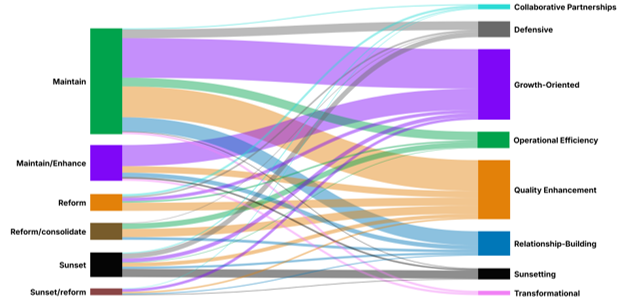
The APR has reestablished expectations for portfolio stewardship and discipline. Early outcomes include the sunsetting of low-enrolled programs, reduction of unnecessary concentrations, simplification of degree pathways, and improved catalog accuracy. The process also resulted in the completion of all past-due and current-cycle program reviews, strengthening accountability and compliance.
As the APR has moved from design to implementation, its scope and impact have exceeded initial expectations, advancing UIS’s capacity for transparent, mission-aligned, and data-informed academic planning. The next phase will focus on monitoring progress and collecting program updates in January 2027 to ensure sustained implementation and continuous improvement.
Overall, the APR institutionalized data-informed portfolio management and strengthened alignment between academic offerings and institutional strategy.
Accreditation and Assessment
UIS is well-positioned for the 2027-28 Higher Learning Commission (HLC) reaffirmation, with foundational planning structures now in place. Key elements, including timelines, committee structures, engagement expectations, and volunteer frameworks, have been established and supported through presentations to campus governance and leadership groups to strengthen institutional awareness and engagement.
The HLC Steering Committee, chaired by Dr. Lan Dong, is coordinating development of the assurance argument. The Quality Initiative Steering Committee has advanced implementation planning for advising improvements, including data-informed approaches to course scheduling and student success.
Complementing accreditation preparation, institutional assessment infrastructure has been reestablished through the launch of the Assessment Advisory Board, strengthening governance and clarifying campus-wide expectations. General education assessment work has been restarted and advanced in collaboration with UIS faculty, renewing progress in a key area of institutional effectiveness.
Capacity for sustained accreditation and assessment support was significantly strengthened with the hiring of Dr. Steven Feldman as Associate Director of Assessment and Accreditation in June 2026, positioning the institution for continued progress toward reaffirmation and ongoing improvement.
Collectively, these efforts strengthened UIS’s readiness for reaffirmation, reestablished a sustainable assessment infrastructure, and reinforced a culture of continuous improvement and accountability.
Institutional Effectiveness and Operational Improvements
Institutional effectiveness and operational efficiency improved through targeted changes in course scheduling, program oversight, and academic processes.
Course scheduling reform is advancing through OIRE’s co-leadership of the HLC Quality Initiative scheduling task group. Stakeholder feedback identified key inefficiencies, and work is underway to implement a revised scheduling grid to improve classroom utilization and optimize course delivery. Complementing this effort, ongoing analysis supported reductions in low-enrolled course sections, contributing to more effective resource allocation and alignment between course offerings and student demand.
Operational improvements further enhanced institutional effectiveness. OIRE is reorganizing the IBHE Program Review archives into a structured, unit- and year-based system, improving accessibility and readiness for future review and inventory work. In addition, development of a web-based Levels of Governance (LOG) chart is underway to improve transparency and clarity in academic processes and decision-making.
Collectively, these efforts strengthen institutional infrastructure, improve operational efficiency, and support more disciplined, data-informed academic management.
Data, Analytics and Decision Support
Data-informed decision-making capacity expanded significantly through enhanced analytics, reporting, and decision-support tools. Key contributions included course enrollment monitoring, program economic feasibility analysis, and analytical support for strategic planning and academic administration.
Capacity was further strengthened by the addition of ITTA/Data Analyst Harsha Chamala in September 2025. Dashboard development advanced reporting capabilities, including the Career Outcomes dashboard and additional tools supporting academic administration, planning, and decision-making.
Campus-wide collaboration around data resources and analytic priorities also improved through the successful reconvening of the Institutional Data Advisory Group, which engaged more than 30 participants in discussions of data governance, reporting needs, and institutional analytics.
Collectively, these efforts strengthened UIS’s ability to use data more strategically in planning and decision-making.
Student Success, Surveys, and Strategic Initiatives
Student success efforts were strengthened through coordinated survey administration, data-informed analysis, and active engagement in institutional strategy development.
Institution-wide survey initiatives advanced with the administration of the University Experience Survey (in partnership with SoundRocket) and the National Survey of Student Engagement (NSSE) in collaboration with the Center for Postsecondary Research. To ensure results translated into action, the University Experience Survey Action Group was established to guide implementation of improvement strategies. A revised university survey policy was also finalized, improving coordination, timing, and oversight of survey administration across campus.
Complementing these efforts, OIRE supported institutional retention strategy development as a member of the Retention Steering Committee, contributing benchmarking, analysis, and recommendations aligned with student success priorities. Engagement in the Student Success through LeadersHIP Committee and the UIS Success Implementation Team further strengthened alignment between data analysis and implementation planning.
Collectively, these efforts enhanced the institution’s ability to use evidence to inform student success strategies, strengthen cross-unit coordination, and translate insights into actionable improvements.
Institutional Reporting and Compliance
OIRE maintained full compliance with all required reporting, including HLC submissions (Institutional Update and Financial Indicators), federal and IBHE reporting, University of Illinois System reporting, U.S. News surveys, and programmatic accreditation data requests.
The office also substantially reduced a multi-year backlog of UIS census data book reports and continued to respond to ad hoc institutional data requests, improving data availability, consistency, and reliability across campus.
Collectively, these efforts ensured regulatory compliance while strengthening institutional reporting infrastructure.
Academic Affairs Strategic Planning
OIRE played a central role in supporting the development and adoption of a purpose statement and 2026–28 strategic goals for Academic Affairs. This work included coordinating input, synthesizing priorities, and supporting alignment across academic leadership.
Collectively, these efforts aim to strengthen strategic clarity, improve alignment across initiatives, and provide a more focused framework for prioritization and decision-making across the division.
External Visibility, Leadership, and Recognition
OIRE increased national and system-wide visibility through scholarship, conference presentations, professional leadership, and external engagement that highlighted UIS’s work in institutional effectiveness and academic planning. Presentations were delivered at key venues including UPCEA, the Higher Learning Conference, the Digital Teaching & Learning Conference, the Illinois Association for Institutional Research, and the University of Illinois Data Summit. Dr. Michele Gribbins also co-authored a peer-reviewed article in the Journal of Educational Technology and Online Learning, further contributing to the field.
The office also demonstrated strong leadership through active participation in professional organizations and University of Illinois System initiatives. Dr. Gribbins completed her term on the UPCEA Finance Committee and now serves on the UPCEA Policy Committee, while Dr. Matt Suda was elected Vice President/President-Elect of the Illinois Association for Institutional Research.
At the system level, OIRE staff contributed to multiple governance and strategy efforts, including the Enterprise Systems Governance Committee, Data Management & Analytics Subcommittee, Data Strategy Advisory Group, Digital Risk Council, Federated Data Governance Committee, and system-level search committees.
OIRE staff received significant recognition for their contributions. Dr. Gribbins was honored with the Chancellor’s Academic Professional Excellence Award and Employee of the Month, and Harsha Chamala received 2nd Place in the University of Illinois Data Visualization Contest.
Collectively, these efforts enhanced UIS’s reputation, strengthened professional partnerships, and reinforced OIRE’s role as a leader in institutional research and effectiveness at both the state and national levels.
Summary
During FY26, OIRE advanced major institutional priorities through full implementation of the Academic Portfolio Review, strengthened accreditation readiness, and expanded data-informed decision-making and reporting capabilities. The office also played a central role in shaping Academic Affairs strategic planning (2026–28 goals), supporting student success initiatives, and improving operational effectiveness across academic processes. In addition, OIRE elevated UIS’s visibility and influence through external leadership, scholarship, and system engagement.
Collectively, these efforts strengthened institutional effectiveness, strategic alignment, and UIS’s capacity for continuous improvement.