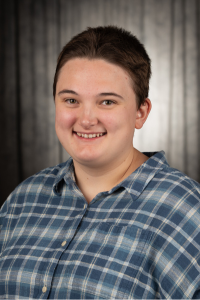
Morell Old
Clinical Assistant Professor / Digital Instruction Librarian
What do you like about your job?
I like that I do different kinds of tasks every day and talk to many different people, which keeps me from getting bored. I meet one-on-one with students to help them find sources for their research; develop and teach workshops on using library search tools; staff the circulation desk; and design instructional materials such as videos, research guides and Canvas modules. I learn a great deal from the students and faculty I work with across the university, as well as from my colleagues in the library. I enjoy the scavenger hunt of looking for information on students’ different research topics, and I also find satisfaction in refining a lesson plan or learning object to keep it concise and effective.
Do you have any side projects or personal goals you are working on?
I gave a lightning talk at Terror Camp, a virtual fandom and academic conference about polar studies, titled “Five Things About Greenland Sharks (and How We Know Them).” The talk explored how knowledge about Greenland sharks has been constructed through a combination of scientific research and Indigenous traditional knowledge. Greenland sharks can live longer than any other vertebrate, and I find it fascinating how scientists figured that out by carbon-dating the lenses of their eyes. As an undergraduate, I double-majored in biology and classics, and it was fun to apply my biology background to understanding shark research.
Recently, I’ve been researching the artist Mark Rothko, a rabbit hole I fell into after becoming a fan of actor Alfred Molina and enjoying his portrayal of Rothko in the play Red. I have no academic background in art history, so it has been an interesting challenge to teach myself about abstract expressionism from scratch. I have visited Rothko paintings on display at the UIUC art museum, the Art Institute of Chicago and the St. Louis Art Museum. I do not really think I “get” them, but I do enjoy looking at them.
Is there a book, movie or TV show that you recently watched and liked?
As a librarian, I would be remiss if I did not talk about books. I have been reading a great deal about Greenland sharks and Mark Rothko, but I also recently enjoyed The Way Back by Gavriel Savit. It is a historical fantasy young adult novel about two Jewish children who track down the Angel of Death. I do not usually read young adult fiction, but the book was recommended by a friend who works in the book section of a toy store, and I liked it a great deal.
Where have you lived or traveled?
I have lived in several different places and enjoyed each for different reasons. I went to high school in the Washington, D.C., suburbs and was spoiled by being close to the museums in Washington and the excellent restaurants in Northern Virginia. I attended Grinnell College in Grinnell, Iowa, for my undergraduate studies, which increased my appreciation for the prairie and the beauty of the land there. My friends and I also visited Des Moines frequently; the Des Moines Symphony Orchestra offered $10 student tickets.
After graduating from Grinnell, I moved to Madison, Wisconsin, for graduate school, which is also a great city. I was able to spend more time with my family, who live in Wisconsin, and developed a deeper appreciation for Madison culture. As far as I am concerned, Woodman’s is the best grocery store in the universe.
Now I am discovering the things I love about Springfield. So far, the Sangamon Valley Trail has been a highlight.
Who’s someone (mentor) who has had a significant impact on your life (career)?
I have had many excellent teachers and professors throughout my life, but the professors I studied with in classics at Grinnell College probably had the most significant impact on me. They were strong role models for what academic work looks like and demonstrated the value of careful planning, attention to detail and making good use of time when reading, writing and teaching. Learning to construct a clear, well-supported argument that flows logically from one step to the next in papers on ancient Greek poetry taught me the same skills I use now when I write a research guide using backward design.