Department(s):
School of Integrated Sciences, Sustainability, and Public Health
Title(s):
Professor
Area of Specialization
environment, anthropology, sustainability, agriculture, Kenya, United States
Degrees: Ph.D., MA, Environmental Anthropology, University of Washington, Seattle, WA
B.A. Anthropology, Environmental Studies (Social Science Track), Washington University in St. Louis, summa cum laude
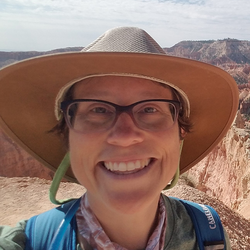
Bio: Dr. Megan Styles is an Professor of Environmental Studies (ENS) and the current ENS Program Lead. She joined the UIS faculty in 2014 after completing a teaching post-doc with the Program on the Environment at the University of Washington. Her research focuses on sustainable development in Kenya and the United States, especially issues related to agriculture. At UIS, she is the faculty advisor for the UIS Community Garden and the student-led UIS Green Fee Committee. She loves working closely with students to make our campus and our broader community more sustainable. Locally, she serves on the Lincoln Memorial Garden Executive Board.
As a environmental anthropologist, Dr. Styles specializes in ethnographic and qualitative research. She has researched the social and environmental effects of cut flower farming in Kenya since 2004 and has worked with students to examine issues closer to home, including community gardening in Springfield and recycling behaviors on the UIS campus. Her current research project examines U.S. farmers' experiences with hemp production. She has also worked as an applied anthropologist with NOAA Fisheries and as an environmental educator with AmeriCorps.
Dr. Styles looks forward to working with students who want to use qualitative methods (e.g. interviews, surveys, participant observation, and participatory action research) or mixed methods (e.g. a combination of qualitative social science methods and natural science/quantitative methods) to examine the social, economic, and political dimensions of contemporary environmental problems (broadly defined) in the United States or abroad. Her masters and DPA students have examined issues as diverse as what motivates people to participate in marine citizen science programs, minority farmer participation in farm-to-table initiatives, the social and ecological effects of yarsagumba (Chinese caterpillar fungus) harvesting in rural Nepal, and the use of children's books in environmental education. If you are interested in working with Dr. Styles, contact her at mstyl2@uis.edu.
Courses Taught: ENS 271 Introduction to Sustainability, ENS 411 Environmental Education, ENS 418 American Environmental History, ENS 448 Sustainable Food Systems, ENS 451 Undergraduate Capstone, ENS 449 Agricultural Politics and Policy, ENS 489 African Environments, ENS 550 Capstone Closure, ENS 552 Environmental Social Sciences and Humanities.
Academic Publications: https://orcid.org/0009-0002-1532-190X